If torpor isn't defined by body temperature but it's about "metabolic rate" then why is the diapause of the ants (other insects also participate) not considered torpor?
-
@IngaLovinde @futurebird (MegaHAL was an open source chatbot program from around the year 2000 that, when given text input, added it to a markov chain text model and generated "conversational" responses. Back in the day I hooked it up to both IRC and AOL Instant Messenger, and I actually witnessed it passing the Turing Test, not because MegaHAL was smart, but because people are very prone to seeing the work of minds in random data.)
@mcc @futurebird oh I didn't know that, thought that your mention of MegaHAL was a reference to HAL (instead of referencing actual text generator that was named after HAL)
-
@futurebird @lemgandi @moira @Photo55
S. invicta is native to tropical and subtropical parts of S. America, so I'd be surprised if their nests maintain substantial internal heat. It seems more likely their nests would evolve to get rid of heat.
-
I don't know anymore.
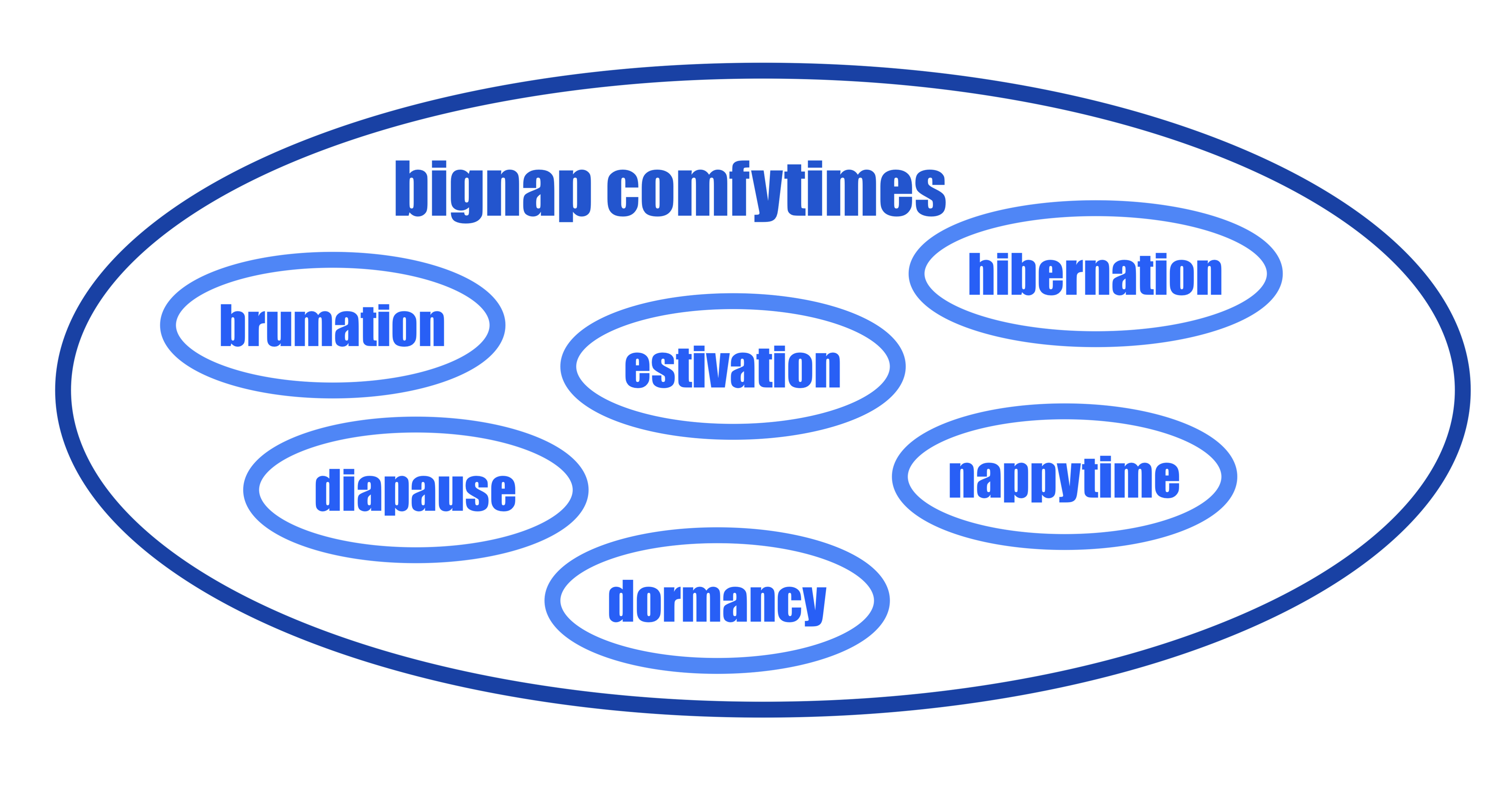
diapause seems like the most general term? so everything that hibernates is in diapause.I need an Euler diagram STAT of:
hibernation
estivation (or aestivation?)
diapause
dormancy
brumation
napping
torporWith the differences and various example animals.
(If AI did what it claimed this would be a great task to ask from AI, but, in fact, this is the kind of thing LLMs are the worst at: making categorizations logically... and not making up animals)
@futurebird @Photo55 I can contribute a little.
Brumation is what reptiles and amphibians do. It's distinct from mammalian hibernation in several ways (and you probably know a lot more about invertebrate diapause than I do).
During brumation, reptiles and amphibians don't sleep all the time - they dramatically drop their metabolic rate, but will sometimes move around a bit. Unlike hibernating mammals, they need to drink water. Also unlike mammalian hibernation, brumating animals will usually fast for a week or two before entering brumation (rather than stuffing themselves like mammals do) - this is to make sure that there is nothing left in the gut that could start rotting while the metabolism is slowed. They burn glycogen and fat while brumating, but *very* little.
A couple anecdotal observations: I weighed Igor - my male Northern blue-tongue skink - before and after his first brumation in my care; he lost 7 grams (he weighed just under a kilo at the time). *Every* brumating reptile I've seen seems to have their brain running on a severely limited autopilot while it's going on: They know how to get water and getting back in the cave or box they're hiding in, but that's about it. I can very easily tell when Igor is just coming out for water and when winter's over by his gaze alone: When he's just coming out for water he looks "dim", when he's done brumating he makes eye contact, watches what's going on and looks much more like "the lights are on" in there.

-
@futurebird @Photo55 I can contribute a little.
Brumation is what reptiles and amphibians do. It's distinct from mammalian hibernation in several ways (and you probably know a lot more about invertebrate diapause than I do).
During brumation, reptiles and amphibians don't sleep all the time - they dramatically drop their metabolic rate, but will sometimes move around a bit. Unlike hibernating mammals, they need to drink water. Also unlike mammalian hibernation, brumating animals will usually fast for a week or two before entering brumation (rather than stuffing themselves like mammals do) - this is to make sure that there is nothing left in the gut that could start rotting while the metabolism is slowed. They burn glycogen and fat while brumating, but *very* little.
A couple anecdotal observations: I weighed Igor - my male Northern blue-tongue skink - before and after his first brumation in my care; he lost 7 grams (he weighed just under a kilo at the time). *Every* brumating reptile I've seen seems to have their brain running on a severely limited autopilot while it's going on: They know how to get water and getting back in the cave or box they're hiding in, but that's about it. I can very easily tell when Igor is just coming out for water and when winter's over by his gaze alone: When he's just coming out for water he looks "dim", when he's done brumating he makes eye contact, watches what's going on and looks much more like "the lights are on" in there.
@datarama @futurebird @Photo55 Ah! Thank you! Now I can put a sign on my door as necessary which says 'brumating'. I definitely have weeks like that!
-
@datarama @futurebird @Photo55 Ah! Thank you! Now I can put a sign on my door as necessary which says 'brumating'. I definitely have weeks like that!
@Bumblefish @datarama @futurebird tempting.
-
@futurebird @Photo55 I can contribute a little.
Brumation is what reptiles and amphibians do. It's distinct from mammalian hibernation in several ways (and you probably know a lot more about invertebrate diapause than I do).
During brumation, reptiles and amphibians don't sleep all the time - they dramatically drop their metabolic rate, but will sometimes move around a bit. Unlike hibernating mammals, they need to drink water. Also unlike mammalian hibernation, brumating animals will usually fast for a week or two before entering brumation (rather than stuffing themselves like mammals do) - this is to make sure that there is nothing left in the gut that could start rotting while the metabolism is slowed. They burn glycogen and fat while brumating, but *very* little.
A couple anecdotal observations: I weighed Igor - my male Northern blue-tongue skink - before and after his first brumation in my care; he lost 7 grams (he weighed just under a kilo at the time). *Every* brumating reptile I've seen seems to have their brain running on a severely limited autopilot while it's going on: They know how to get water and getting back in the cave or box they're hiding in, but that's about it. I can very easily tell when Igor is just coming out for water and when winter's over by his gaze alone: When he's just coming out for water he looks "dim", when he's done brumating he makes eye contact, watches what's going on and looks much more like "the lights are on" in there.
@datarama @futurebird
It isn't any specialism of mine, but I gathered at least some hibernating placentals will wake up a bit on a warm day in winter, whether they go and get a sip of water I don't know. -
@datarama @futurebird
It isn't any specialism of mine, but I gathered at least some hibernating placentals will wake up a bit on a warm day in winter, whether they go and get a sip of water I don't know.@Photo55 @futurebird That's possible, but they *can* sleep through an entire winter without drinking; reptiles and amphibians can't.
-
I don't know anymore.
diapause seems like the most general term? so everything that hibernates is in diapause.I need an Euler diagram STAT of:
hibernation
estivation (or aestivation?)
diapause
dormancy
brumation
napping
torporWith the differences and various example animals.
(If AI did what it claimed this would be a great task to ask from AI, but, in fact, this is the kind of thing LLMs are the worst at: making categorizations logically... and not making up animals)
Here's a review paper by some collaborators on dormancy, which might be helpful? Part of the reason they wrote it was to try and unify understanding across different types of animals.
-
Maybe just what you just said? “Ants do something like hibernation”. @moira @Photo55 @futurebird
@BenAveling @moira @Photo55 @futurebird
Might be most straightforward to say "ants go dormant" as a concept that can be understood? Avoid semantic arguments?
-
@futurebird @lemgandi @moira @Photo55
S. invicta is native to tropical and subtropical parts of S. America, so I'd be surprised if their nests maintain substantial internal heat. It seems more likely their nests would evolve to get rid of heat.
@llewelly @futurebird @lemgandi @moira @Photo55
The endothermy in bees is related to use of their flight muscles...most of what I've observed suggests that while ants are very temperature sensitive (e.g. repositioning brood to take advantage of temperature gradients), they're unlikely to display nearly as much endothermy as bees.
-
@futurebird @lemgandi @moira @Photo55
S. invicta is native to tropical and subtropical parts of S. America, so I'd be surprised if their nests maintain substantial internal heat. It seems more likely their nests would evolve to get rid of heat.
@llewelly @futurebird @moira @Photo55
Ah, well taken. Still, next summer it might be fun to get out there with a thermometer. I'd have to figure out an ant-proof way to insert it. Or maybe just put it in, run away, and come back later.
Even with that neotropical origin, they seem to do pretty well here in North Georgia, where the outside temperature dipped into the teens a couple of days ago.
-
@llewelly @futurebird @moira @Photo55
Ah, well taken. Still, next summer it might be fun to get out there with a thermometer. I'd have to figure out an ant-proof way to insert it. Or maybe just put it in, run away, and come back later.
Even with that neotropical origin, they seem to do pretty well here in North Georgia, where the outside temperature dipped into the teens a couple of days ago.
@lemgandi @futurebird @moira @Photo55
Georgia is subtropical anyway, and not that different climate-wise from northern Argentina, which is the southern limit of the natural range of S. invicta , and occasional dips down into the teens (Fahrenheit) occur there also. -
@futurebird @Photo55 i mean this is all i got and it's not good
-
@futurebird @Photo55 i mean this is all i got and it's not good
@moira @futurebird @Photo55 I hate to interrupt, but it's an interesting coincidence that Lindsey Nicole just released a video about this very subject-- https://www.youtube.com/watch?v=EKMUucn-Pz4
-
@moira @futurebird @Photo55 I hate to interrupt, but it's an interesting coincidence that Lindsey Nicole just released a video about this very subject-- https://www.youtube.com/watch?v=EKMUucn-Pz4
That is the video that started my confusion. (I added it to fediTV, the shared youTube playlist that I've been trying to get people to add things they watch to)