Normally when I read a book I don't like to know too much about the author.
-
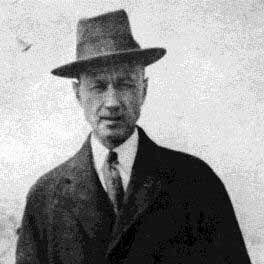
For example, the ants encounter a myrmecologist who they regard as a hazard, hapless and baffling. The myrmecologist rides a bicycle: they call him "Wheeler."
*waggles eyebrows*
WHEELER? Get it?
It's this guy:
Wheeler was a contemporary of Grove. I wonder if they met?
...or if, like me, he just got sick of seeing the guy's name on every ant species.
(Wheeler is no slouch, coined the term 'superorganism' )
If you know anything of Mr. Grove let me in on it.
3/3
@futurebird Grove is always taught in CanLit classes, esp Master of the Mill.
In my recollection, he used ants as positive symbols of his world of Ontario settler homesteaders but ultimately powerless in rising urban industrialization.
This is a good book review mentioning the Canadian history aspects of his ant novel. https://www.depauw.edu/sfs/backissues/58/proietti58art.htm
-
@futurebird Grove is always taught in CanLit classes, esp Master of the Mill.
In my recollection, he used ants as positive symbols of his world of Ontario settler homesteaders but ultimately powerless in rising urban industrialization.
This is a good book review mentioning the Canadian history aspects of his ant novel. https://www.depauw.edu/sfs/backissues/58/proietti58art.htm
Thank you for finding this essay. It's not the only one that suggests that the ants in the book are a "utopian society" and uses that lens to examine the work.
But, it's the ants themselves who claim they are superior and civilized, the joke is that they aren't no one is.
For example our narrator, a leaf-cutter ant, proud pacifist and vegetarian laments that other ants always myopically think they are the pinnacles of creation. Not recognizing she herself is the same.
-
Thank you for finding this essay. It's not the only one that suggests that the ants in the book are a "utopian society" and uses that lens to examine the work.
But, it's the ants themselves who claim they are superior and civilized, the joke is that they aren't no one is.
For example our narrator, a leaf-cutter ant, proud pacifist and vegetarian laments that other ants always myopically think they are the pinnacles of creation. Not recognizing she herself is the same.
@futurebird @AnnaAnthro I told my children from a very young age: "Humans are the most advanced form of life on Earth, according to every metric humans have devised to measure greatness."
-
Thank you for finding this essay. It's not the only one that suggests that the ants in the book are a "utopian society" and uses that lens to examine the work.
But, it's the ants themselves who claim they are superior and civilized, the joke is that they aren't no one is.
For example our narrator, a leaf-cutter ant, proud pacifist and vegetarian laments that other ants always myopically think they are the pinnacles of creation. Not recognizing she herself is the same.
Yes the book describes a world where males are mostly irrelevant. That's how ants really operate. But it's not a world free from intrigue, deceit, dominance and war.
Our vegetarian, pacifist, scientist narrator thinks nothing of giving a pheromone to one of her most loyal subjects that causes her to die basically "for national security reasons" which she rationalizes convincingly.
The next night this dangerous pheromone kills thousands of ants, their bodies forming mountains.
-
Normally when I read a book I don't like to know too much about the author. But, at last I've had to go find out who is this "Frederick Philip Grove."
He's mostly famous, not for his science fiction book "Consider Her Ways" about ants-- but his books about "life on the prairie" in Canada.
This sounds dreary to me. But I will check it out.
"Consider Her Ways" was the last fiction book he wrote and I don't think any review I've read of it understands it at all.
1/
It might a good time to brush up on all things Canadian.
-
I'm seriously thinking about doing a youTube "read along" with images to illustrate some of the ants mentioned, and notes about where he's correct about ants and where's it's wrong.
This is complicated by the fact that the story is told by an unreliable ant narrator... and that the unreliable of the narrator is one of the major themes.
It could be fun.
Fedi book club?
-
Yes the book describes a world where males are mostly irrelevant. That's how ants really operate. But it's not a world free from intrigue, deceit, dominance and war.
Our vegetarian, pacifist, scientist narrator thinks nothing of giving a pheromone to one of her most loyal subjects that causes her to die basically "for national security reasons" which she rationalizes convincingly.
The next night this dangerous pheromone kills thousands of ants, their bodies forming mountains.
I almost thought this was a little heavy handed: using power to kill, no matter how comprehensive and compelling the reasoning has expansive consequences as it violates a core value.
Nonetheless both ants and people rationalize such death all of the time. And like the narrator we sense the consequences of our actions only dimly.
But I could be projecting my own values on to this work. That is possible too.
-
Thank you for finding this essay. It's not the only one that suggests that the ants in the book are a "utopian society" and uses that lens to examine the work.
But, it's the ants themselves who claim they are superior and civilized, the joke is that they aren't no one is.
For example our narrator, a leaf-cutter ant, proud pacifist and vegetarian laments that other ants always myopically think they are the pinnacles of creation. Not recognizing she herself is the same.
@futurebird If I remember Grove’s other works, he is quite reflexive about the smugness of his Lake Simcoe Ontario & Manitoba homesteader world. They see themselves as morally superior, esp vis a vis Toronto.
As someone raised in Berlin, it must’ve been quite clear to him.
That the ants mirror this kinda fits.
-
For example, the ants encounter a myrmecologist who they regard as a hazard, hapless and baffling. The myrmecologist rides a bicycle: they call him "Wheeler."
*waggles eyebrows*
WHEELER? Get it?
It's this guy:
Wheeler was a contemporary of Grove. I wonder if they met?
...or if, like me, he just got sick of seeing the guy's name on every ant species.
(Wheeler is no slouch, coined the term 'superorganism' )
If you know anything of Mr. Grove let me in on it.
3/3
Would you write the companion to this book ?
One which explains everything a reader needs to know in order to understand the book ?(or, more realistically, start a website where enthusiast myrmecologists will collaboratively write that companion ?)
-
I'm seriously thinking about doing a youTube "read along" with images to illustrate some of the ants mentioned, and notes about where he's correct about ants and where's it's wrong.
This is complicated by the fact that the story is told by an unreliable ant narrator... and that the unreliable of the narrator is one of the major themes.
It could be fun.
-
Normally when I read a book I don't like to know too much about the author. But, at last I've had to go find out who is this "Frederick Philip Grove."
He's mostly famous, not for his science fiction book "Consider Her Ways" about ants-- but his books about "life on the prairie" in Canada.
This sounds dreary to me. But I will check it out.
"Consider Her Ways" was the last fiction book he wrote and I don't think any review I've read of it understands it at all.
1/
I remember the title but realised it was the Wyndham book of the same name. It's only CAD$3 on Kobo via Indigo books in Canada, so added to my virtual "to read" pile.
I started E.O. Wilson's Anthill: a novel, but didn't get into it.
My favourite ant(hill) character is Aunt Hillary, in the prelude to each chapter of Hofstadter's Gödel, Escher, Bach, though it's a very long time since I read it.
Now I'm wondering how many fiction books there are, featuring ants.
-
I remember the title but realised it was the Wyndham book of the same name. It's only CAD$3 on Kobo via Indigo books in Canada, so added to my virtual "to read" pile.
I started E.O. Wilson's Anthill: a novel, but didn't get into it.
My favourite ant(hill) character is Aunt Hillary, in the prelude to each chapter of Hofstadter's Gödel, Escher, Bach, though it's a very long time since I read it.
Now I'm wondering how many fiction books there are, featuring ants.
"Now I'm wondering how many fiction books there are, featuring ants."
Not enough. But, we work daily and with great dedication to correct this issue.
-
"Now I'm wondering how many fiction books there are, featuring ants."
Not enough. But, we work daily and with great dedication to correct this issue.
@futurebird @EricLawton The ants in Children of Time are unfortunately on the losing side of their epic struggle with the spiders.
 ️
️ 
-
I remember the title but realised it was the Wyndham book of the same name. It's only CAD$3 on Kobo via Indigo books in Canada, so added to my virtual "to read" pile.
I started E.O. Wilson's Anthill: a novel, but didn't get into it.
My favourite ant(hill) character is Aunt Hillary, in the prelude to each chapter of Hofstadter's Gödel, Escher, Bach, though it's a very long time since I read it.
Now I'm wondering how many fiction books there are, featuring ants.
@EricLawton And I remember, unfortunately, only very vaguely, a wonderful feature film in which a rather quirky ant researcher from earlier times (19th c or beginning 20th) appeared, who had really existed. I can't remember the film even with the best will but would like to see it gain!
-
"Now I'm wondering how many fiction books there are, featuring ants."
Not enough. But, we work daily and with great dedication to correct this issue.
@futurebird @EricLawton This is my personal favorite.

The Colony: A Political Tale
Read reviews from the world’s largest community for readers. "The A Political Tale" is an allegory about foreign policy told through two colonies of ants.…
Goodreads (www.goodreads.com)
-
"Now I'm wondering how many fiction books there are, featuring ants."
Not enough. But, we work daily and with great dedication to correct this issue.
@futurebird @EricLawton Children of Time by Adrian Tchaikovsky
-
"Now I'm wondering how many fiction books there are, featuring ants."
Not enough. But, we work daily and with great dedication to correct this issue.
@futurebird @EricLawton there are in some of the discworld books
-
"Now I'm wondering how many fiction books there are, featuring ants."
Not enough. But, we work daily and with great dedication to correct this issue.
Is there a section with ants in The Once and Future King, or am I misremembering?
That's the first thing that comes to mind when I think about ants in fiction, but considering how uncertain I am, it's probably not a great example!
-
@EricLawton And I remember, unfortunately, only very vaguely, a wonderful feature film in which a rather quirky ant researcher from earlier times (19th c or beginning 20th) appeared, who had really existed. I can't remember the film even with the best will but would like to see it gain!
-
"Now I'm wondering how many fiction books there are, featuring ants."
Not enough. But, we work daily and with great dedication to correct this issue.
@futurebird
Watership Down but ants?
@EricLawton