A forum for discussing and organizing recreational softball and baseball games and leagues in the greater Halifax area.
Better don’t give martials any weapons and casters no spellcasting then…
-
This post did not contain any content.This is basically 5e sneak attack anyway (the 'not having it' aspect that is) You can only get a sneak attack if you have advantage on an enemy, and you know what? You don't have advantage on an enemy just cause you're flanking them, that's mentioned in the book as an optional rule the DM can allow (where flanking gives advantage) but isn't the usual rule. In 3e/3.5e/PF, an enemy being flanked confers benefits including allowing sneak attacks. In 5e the only way to sneak attack without needing advantage is by taking the swashbuckler (specialization? Archetype?).
-
Specialization is good, because when everybody in the party is good at one narrow field we all get to take turns doing cool things. If you make a character that's good at everything, nobody else gets to do anything.> Specialization is good, because when everybody in the party is good at one narrow field we all get to take turns doing cool things. This is the premise behind Konosuba. The party leader is a generalist adventurer and everyone else hyper specializes: max CON 0 DEX tank, EXPLOSION wizard, and cleric with a wisdom dump stat.
-
I once played with a DM that strictly ruled that rogues didn't get a sneak attack bonus unless I was in stealth and undetected by the enemy. (As he said its in the name: SNEAK attack) I brought up I could probably make that still work with a bow and I was immediately preemptively banned from using ranged weapons lol. That was a frustrating game.In one campaign my DM said that the risk versus reward balance was off when using attack from *hidden, move, hide* each round on my Halfling Arcane Trickster. I countered that scenario was the reason I picked Halfling, and otherwise I would have been an Elf. He let me give up a cool elven made ranged weapon in an arcane ritual to permanently race change to Elf. I then proceeded to use Flanking to attack with super-advantage from Elven Accuracy, using Booming Blade. I followed up with Cunning Action Disengage if the target wasn't dead. It had the appearance of risk because it was a melee attack, but it was almost as safe as when I was hiding.
-
This is basically 5e sneak attack anyway (the 'not having it' aspect that is) You can only get a sneak attack if you have advantage on an enemy, and you know what? You don't have advantage on an enemy just cause you're flanking them, that's mentioned in the book as an optional rule the DM can allow (where flanking gives advantage) but isn't the usual rule. In 3e/3.5e/PF, an enemy being flanked confers benefits including allowing sneak attacks. In 5e the only way to sneak attack without needing advantage is by taking the swashbuckler (specialization? Archetype?).> In 5e the only way to sneak attack without needing advantage is by taking the swashbuckler (specialization? Archetype?). Actually, since 5e this has been rolled this into the standard sneak attack that every Rogue gets >You don't need Advantage on the attack roll if at least one of your allies is within 5 feet of the target, the ally doesn't have the Incapacitated condition, and you don't have Disadvantage on the attack roll. So you don't need flanking, you just need a buddy who is not unconscious.
-
I had a dm once say he was thinking about saying no about my rogue's "I shoot, move, bonus action hide around the corner" loop. But then he said he realized if he said no, my character would suck and it'd be no fun. I think that was the right call.Based on the other comments, some DMs seem to have an issue with that. Did they give a reason? I am extremely confused because I'm pretty sure that's not just the archetype, but also just RAW for rogue. Is there some ambiguity in the wording of the class that I'm just missing?
-
I once played with a DM that strictly ruled that rogues didn't get a sneak attack bonus unless I was in stealth and undetected by the enemy. (As he said its in the name: SNEAK attack) I brought up I could probably make that still work with a bow and I was immediately preemptively banned from using ranged weapons lol. That was a frustrating game.I've been hearing about DM's complaining about Rogues SA since 3.x days. These are the same guys who (allegedly) thought the monk was more powerful that the sorcerer because the monk's chart had so many more columns and class features. Why did you even play with this guy?
-
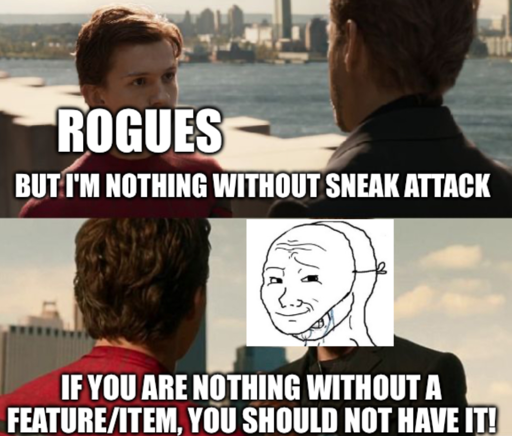
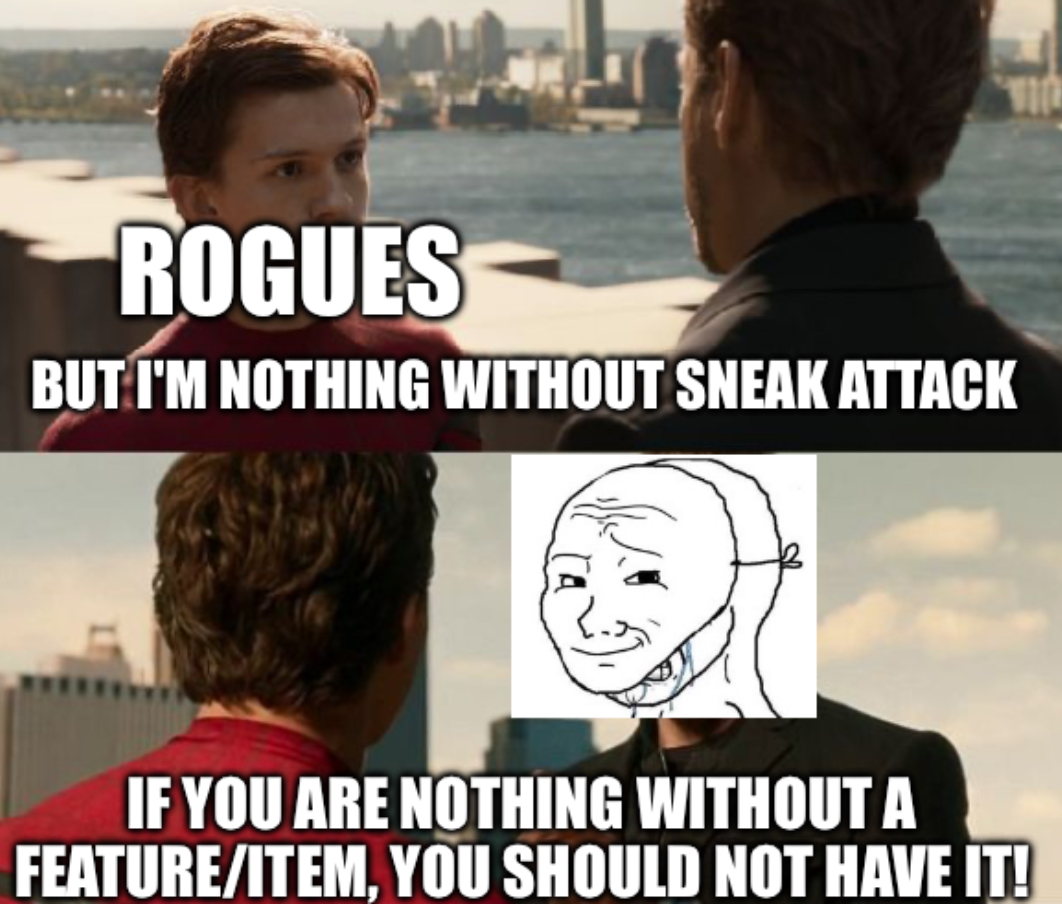
Based on the other comments, some DMs seem to have an issue with that. Did they give a reason? I am extremely confused because I'm pretty sure that's not just the archetype, but also just RAW for rogue. Is there some ambiguity in the wording of the class that I'm just missing?"it seems silly that you can just go around the corner and suddenly you're hidden. They know you're there" This was rebutted with "they know I'm somewhere over there, but not exactly where or when I'm going to pop out. I'm a 7th level rogue, I'm sure I have tricks you and I can't even think of". Sometimes people get like selectively simulationist. They'll ignore most of the game's gamey bits (inventory management, hit points and recovery, magic) but some things throw them off. Usually things that are closer to lived reality. For example, someone having no problem with a wizard hypnotizing an entire room, but balking at a fighter climbing a tall fence. There was also: "It seems like a lot of damage..." "I'm pretty sure rogue is balanced around doing sneak attack almost every round. The fighter gets multiple attacks, but I don't. Almost every other class gets a resource to burn like spell points or ki points or superiority dice. I have nothing. All I do is sneak attack. Without it, I'm a particularly accurate peasant that can run away real good. And I still miss about a quarter of the time, which means my whole turn accomplishes *nothing*" I wonder if the DMG or something published expected damage per round or per encounter somewhere.
-
> In 5e the only way to sneak attack without needing advantage is by taking the swashbuckler (specialization? Archetype?). Actually, since 5e this has been rolled this into the standard sneak attack that every Rogue gets >You don't need Advantage on the attack roll if at least one of your allies is within 5 feet of the target, the ally doesn't have the Incapacitated condition, and you don't have Disadvantage on the attack roll. So you don't need flanking, you just need a buddy who is not unconscious.Ah, good; honestly I remember taking rogue before this change was made (or perhaps it had been changed at that point but none of us at the table knew) and the problem was immediately evident; there's a lot of stuff in 5e that makes me wonder what the heck the creators were thinking and if perhaps they just rushed the whole thing along and decided to just fix up any oversight later.
-
"it seems silly that you can just go around the corner and suddenly you're hidden. They know you're there" This was rebutted with "they know I'm somewhere over there, but not exactly where or when I'm going to pop out. I'm a 7th level rogue, I'm sure I have tricks you and I can't even think of". Sometimes people get like selectively simulationist. They'll ignore most of the game's gamey bits (inventory management, hit points and recovery, magic) but some things throw them off. Usually things that are closer to lived reality. For example, someone having no problem with a wizard hypnotizing an entire room, but balking at a fighter climbing a tall fence. There was also: "It seems like a lot of damage..." "I'm pretty sure rogue is balanced around doing sneak attack almost every round. The fighter gets multiple attacks, but I don't. Almost every other class gets a resource to burn like spell points or ki points or superiority dice. I have nothing. All I do is sneak attack. Without it, I'm a particularly accurate peasant that can run away real good. And I still miss about a quarter of the time, which means my whole turn accomplishes *nothing*" I wonder if the DMG or something published expected damage per round or per encounter somewhere."Selectively simulationist" is a great way to put it. I think everyone falls victim to that from time to time and I'm definitely stealing your turn of phrase.
-
Based on the other comments, some DMs seem to have an issue with that. Did they give a reason? I am extremely confused because I'm pretty sure that's not just the archetype, but also just RAW for rogue. Is there some ambiguity in the wording of the class that I'm just missing?
-
> In 5e the only way to sneak attack without needing advantage is by taking the swashbuckler (specialization? Archetype?). Actually, since 5e this has been rolled this into the standard sneak attack that every Rogue gets >You don't need Advantage on the attack roll if at least one of your allies is within 5 feet of the target, the ally doesn't have the Incapacitated condition, and you don't have Disadvantage on the attack roll. So you don't need flanking, you just need a buddy who is not unconscious.
-
"it seems silly that you can just go around the corner and suddenly you're hidden. They know you're there" This was rebutted with "they know I'm somewhere over there, but not exactly where or when I'm going to pop out. I'm a 7th level rogue, I'm sure I have tricks you and I can't even think of". Sometimes people get like selectively simulationist. They'll ignore most of the game's gamey bits (inventory management, hit points and recovery, magic) but some things throw them off. Usually things that are closer to lived reality. For example, someone having no problem with a wizard hypnotizing an entire room, but balking at a fighter climbing a tall fence. There was also: "It seems like a lot of damage..." "I'm pretty sure rogue is balanced around doing sneak attack almost every round. The fighter gets multiple attacks, but I don't. Almost every other class gets a resource to burn like spell points or ki points or superiority dice. I have nothing. All I do is sneak attack. Without it, I'm a particularly accurate peasant that can run away real good. And I still miss about a quarter of the time, which means my whole turn accomplishes *nothing*" I wonder if the DMG or something published expected damage per round or per encounter somewhere.I actually don’t like the "magic exist so fuck simulatiounism" reasoning, since it implies the as soon as magic exists, any rational explanations are off the table. I generally prefer to establish what can and can’t be done, so we have as baseline for what’s possible. Otherwise you quickly loose consistency. Martials should be able to do more than regular people in our world, but there should be guidelines on what they can do.
-
In one campaign my DM said that the risk versus reward balance was off when using attack from *hidden, move, hide* each round on my Halfling Arcane Trickster. I countered that scenario was the reason I picked Halfling, and otherwise I would have been an Elf. He let me give up a cool elven made ranged weapon in an arcane ritual to permanently race change to Elf. I then proceeded to use Flanking to attack with super-advantage from Elven Accuracy, using Booming Blade. I followed up with Cunning Action Disengage if the target wasn't dead. It had the appearance of risk because it was a melee attack, but it was almost as safe as when I was hiding.I think people overestimate what hiding can do for you. Hiding does not immediately shield you from harm. You can’t hide if there’s nothing to hide behind. If an enemy walks around your cover, even the best stealth roll in the whole world won’t keep you hidden. How did the DM react to your new strategy?
-
Ah, good; honestly I remember taking rogue before this change was made (or perhaps it had been changed at that point but none of us at the table knew) and the problem was immediately evident; there's a lot of stuff in 5e that makes me wonder what the heck the creators were thinking and if perhaps they just rushed the whole thing along and decided to just fix up any oversight later.This rule has been in the book ever since the PHB first released. If this was something you didn’t use, you either missed it or played a different edition.
-
I actually don’t like the "magic exist so fuck simulatiounism" reasoning, since it implies the as soon as magic exists, any rational explanations are off the table. I generally prefer to establish what can and can’t be done, so we have as baseline for what’s possible. Otherwise you quickly loose consistency. Martials should be able to do more than regular people in our world, but there should be guidelines on what they can do.Well, thankfully I included examples other than magic. However, I do think trying too hard on "martials should be like real life" easily leads to harsher limitations for them. It's not always intentional. But when someone says "I want to leap 15 feet over the chasm" some people get all "you can't do that! I can barely jump five feet and I'm athletic (they're not)" and you have a whole digression where someone looks up human records and then argues about if 16 strength is really Olympic class and what about all your equipment and blah blah blah. It's much rarer for that kind of argument to come up with wizard types, in my experience. Clearer rules up front help, though I feel like half of DND players have never read the rules.
-
Based on the other comments, some DMs seem to have an issue with that. Did they give a reason? I am extremely confused because I'm pretty sure that's not just the archetype, but also just RAW for rogue. Is there some ambiguity in the wording of the class that I'm just missing?
-
I actually don’t like the "magic exist so fuck simulatiounism" reasoning, since it implies the as soon as magic exists, any rational explanations are off the table. I generally prefer to establish what can and can’t be done, so we have as baseline for what’s possible. Otherwise you quickly loose consistency. Martials should be able to do more than regular people in our world, but there should be guidelines on what they can do.Personally I prefer the "classes should feel comparably powerful/capable" model to simulationism. Since we aren't going full locked tomb and saying that mages are all basically chronically ill, I extend it to martials are folk hero strength. A mid level rogue should be capable of Robin Hood level bullshit.
-
I mean, imagine your some hired goon guarding the door to some culty bullshit. You get jumped by a group of do-gooders and as your about to get up to a bit of the old ultra-violence you notice one of these punks has a damned rat sticking out of a pocket, and it's not even dead! That'd be a little distracting at least. Did they train the rat? Is it a magic rat? Is the rat going to jump out and join the fight? Do they have to clean rat droppings out of the pocket every night? Do they keep the rat in a cage when it's not in the pocket? So many unanswered questio.... Fuck I just got stabbed.
-
Well, thankfully I included examples other than magic. However, I do think trying too hard on "martials should be like real life" easily leads to harsher limitations for them. It's not always intentional. But when someone says "I want to leap 15 feet over the chasm" some people get all "you can't do that! I can barely jump five feet and I'm athletic (they're not)" and you have a whole digression where someone looks up human records and then argues about if 16 strength is really Olympic class and what about all your equipment and blah blah blah. It's much rarer for that kind of argument to come up with wizard types, in my experience. Clearer rules up front help, though I feel like half of DND players have never read the rules.I know you did. Not saying you didn’t. I just wanted to mention it. And generally I think you’re right.
-
I think people overestimate what hiding can do for you. Hiding does not immediately shield you from harm. You can’t hide if there’s nothing to hide behind. If an enemy walks around your cover, even the best stealth roll in the whole world won’t keep you hidden. How did the DM react to your new strategy?Halfling racial ability specifically calls out their ability to Hide behind allies. Once Hidden you can't be targeted with ranged attacks. At lower levels that seems *very* powerful. Over time it would probably have been fine, but once my character was an Elf there was no going back. I already had INT as my second highest score since I was an Arcane Trickster, and I did a 2 level dip into Bladesinger to get some additional spell slots and Blade dance for INT to AC, Shield spell, Find Familiar, and a few more fun spells. Elven Accuracy meant Flanking (or any Advantage) was a 14.26% chance to crit, up from 9.75% My DM realized that I was going to blow up his enemies and started adding at least one additional beefy enemy to each fight. This was fine with everyone involved as we wanted a challenge to overcome, without nerfs to base class features.
